Market Opportunity
15.7 million people. One product. No category leader.
15.7 million UK adults take their phone to bed every night. 54% say they’d welcome technology that stops them reaching for it. The premium-willing segment alone is 2.4 million people — a £310 million addressable market for a one-time hardware purchase.
The demand is proven. People already pay £130–170 for premium bedside hardware (Hatch: 500,000+ units. Loftie: 200,000+ units, raised £1.6M seed). But nobody has built the version that gets the phone out of the room AND keeps you reachable. That’s the wedge.
What your shares could be worth
Phase 1 — Pre-Seed (now)
£90,000 raise at £900K valuation cap. Angels’ ~10% stake = £90K entry.
Phase 2 — Launch & Prove
Sell 1,000 units at £109 within 60–90 days. Validate £20 CPA. Prove the model.
Phase 3 — Seed (scale)
£350K–500K raise at £2.5M–3.5M valuation. Angels’ stake now worth £270K–360K — a 3–4x return before a single unit ships at scale.
The numbers are deliberately conservative. 1,000 units. One SKU. One market. The upside from here is Duo, retail, and international — but none of that is priced in.
Investor Dossier · UK · Pre-seed
The secret to a peaceful bedroom
isn't a stronger willpower—it's a smarter boundary.
Away is the only phone-boundary product that gets the phone out of the room entirely, while keeping morning alarms active and an emergency line open for the people who matter most.
Raising £90k from 3 investors · SEIS-eligible · fully funded 1st production run
The problem
71% of UK adults sleep with their phone within reach. Most have tried to leave it outside the room. Almost all have failed.
Mobile phones are designed to keep you hooked. That’s why you tell yourself you’ll leave it in another room. And sometimes, that works — for a night or two. But willpower alone rarely holds long-term. The phone is too useful, too connected to everything that matters.
The problem isn’t addiction. It’s that leaving the phone outside the room means giving up being reachable and reliable when it counts. Away solves this by keeping the emergency line open while the phone stays docked outside. Same peace of mind. Better sleep.
Source: Virgin Media O2 / Censuswide, 2026, n=2,000
Why we're the definitive choice
Everyone else makes you choose between being unplugged and being reachable. We don’t.
Every existing product forces a decision with no upside:
- ✕Lockboxes and app-blockers lock the whole phone — so you’re unreachable. That’s what people can’t accept.
- ✕Bedside clocks get you a nicer alarm — but the phone stays on the nightstand. The problem never leaves the room.
- ✕Do Not Disturb alone is easy to cheat — people don’t trust it enough to walk away.
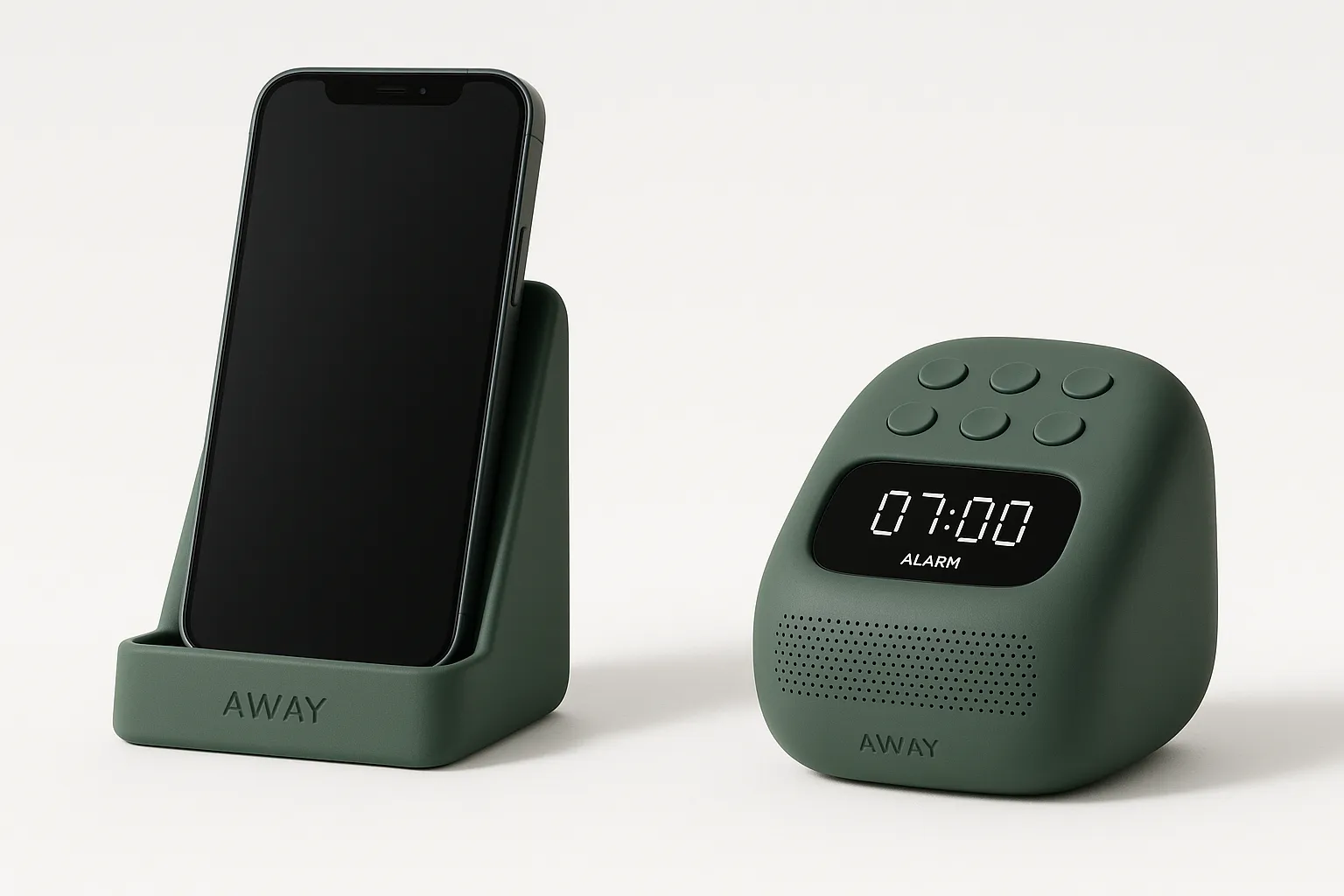
Away keeps your phone in a dock outside the room, with a receiver to let you take calls only from those who matter. Whether it’s a child or an elderly parent, they can still get through, on a device with no way to scroll. That’s the fear, gone. The reason people keep their phone next to them, gone.
How Away compares.
No other product keeps you reachable while keeping the phone out of the room.
| Away | Lockboxes | App Blockers | Bedside Clocks | Do Not Disturb | |
|---|---|---|---|---|---|
| Phone out of bedroom | ✓ | ✓ | — | — | — |
| Emergency line open | ✓ | — | — | — | ✓ |
| Alarms still work | ✓ | — | ✓ | ✓ | ✓ |
| No subscription | ✓ | ✓ | — | — | ✓ |
| Physical receiver in room | ✓ | — | — | ✓ | — |
| Whitelisted calls only | ✓ | — | — | — | ✓ |
| Can't scroll | ✓ | ✓ | — | ✓ | — |
| Charges phone | ✓ | — | — | — | — |
| Patented hardware design | ✓ | — | — | — | — |
The product
A place your phone lives at night, that isn’t your bedside table.
Putting the phone on the Away dock becomes a ritual, like locking the front door or turning off the lights. It’s a small physical action that tells your brain the day is done. No willpower and no app to fight with. Your phone goes to bed when you do.
The Dock
Wall-mounted, outside the room. Phone snaps to a magnetic 45° wedge in one motion. 15W Qi2 wireless charging. A small digital screen shows the time and charging status. The embossed Away wordmark sits subtly on the front tray. Finishes to match the home.
The Receiver
A small, pebble-shaped unit by the bed. A basic digital screen shows the time, your alarm, and who is calling. Four physical buttons: answer, hang up, snooze, stop. Whitelisted calls and alarms come through here. The embossed Away logo sits subtly on the front edge.
The App
A two-minute setup that configures your phone’s own emergency bypass and alarms. Its job is to make the whole thing effortless, then get out of the way.
Configurations: Solo (one phone) · Duo (two phones — the couples setup).
The market
A real, sized market, not a trend slide.
We size this bottom-up, not off a headline ‘digital wellness’ number.
Of ~54m UK adults, ~15.7 million are already problem-aware about their phone at night. The realistically reachable, premium-willing segment is ~2.4 million; a ~£310m one-time device opportunity in the UK alone. Our modelled, obtainable target is £2–4m in annual revenue by Year 3 (15,000–30,000 units/yr), deliberately conservative for a new DTC brand.
People already pay premium prices to get the phone off the nightstand:
Hatch
500,000+ units
A single premium bedside device. Proves willingness to pay.
Loftie
200,000+ units, raised £1.6M seed
Screen-free bedside clock. Validates the category.
The demand is proven. What no one has built is the version that keeps you reachable.
Competition
We know exactly who we’re up against. That includes the free option.
Our advantage is protectable. The dual-unit architecture — a dock outside the room paired with a dedicated receiver inside — is a novel hardware configuration that can be patented. The specific method of whitelisting emergency contacts through a companion receiver device, decoupled from the smartphone itself, is patentable. The industrial design, the magnetic 45° wedge docking mechanism, and the couples SKU architecture all represent defensible IP. We are filing patents on the core system architecture, the receiver-whitelist method, and the industrial design. A funded competitor could try to imitate us, but they would face IP barriers from day one.
Unit economics
The economics, priced for conversion at £109.
Price: £109 retail (Silicone) — positioned below Hatch (£130–170) and Loftie (£149), with a stronger feature set (emergency line + physical buttons + no subscription). Walnut £149. Duo £169.
Cost: Landed cost: £22.50/unit at 1,000-unit runs (excludes tooling). All-in per-unit cost including shipping, packaging, marketing, payment processing, and returns: £54.93 on Run 1 (startup costs add £38.50/unit, bringing the fully-loaded Run 1 cost to £93.43/unit). From Run 2+, startup costs are covered — the ongoing run cost stays at £54.93/unit.
Margin reality: Run 1 net profit: £15,575 (14% margin). Run 2+ net profit: £54,075 per 1,000 units (50% margin). The first run covers all tooling, patent, legal, and compliance costs and still delivers a healthy profit. From Run 2 onwards, margins expand dramatically.
Marketing budget: £20 per unit marketing budget baked in. This is deliberately higher than the category average to maximise chances of a successful first run. At £20 per customer, we break even cleanly; anything below is pure profit. The product pitch is emotionally resonant and visually demonstrable — strong for paid social and organic content.
Manufacturing.
Unit cost estimates based on confirmed manufacturer quotes. Soft-touch silicone enclosure + 15W Qi2 coil + Bluetooth receiver module. Assembly in China, QC in the UK. Full tooling quote received at £10,000.
✅ Real quotes received — figures below are confirmed
| Manufacturer | 1,000u | 10,000u | 50,000u | Lead Time |
|---|---|---|---|---|
| Confirmed supplier Silicone enclosure + Qi2 electronics | £22.50 | £18 | £14 | 6–10 weeks |
Tooling confirmed at £10,000 for injection moulds. Unit cost of £22.50 at 1,000 units includes rigid custom packaging. Wood finish adds £16–32/unit and requires separate CNC tooling. All costs include QC inspection in China before shipping. Shipping £8.50/unit to UK port.
Launch budget
1st Launch Budget — 1,000 units at £109.
All figures below are real, confirmed quotes from our manufacturer and service providers. Total capital required: £93,425 for a full production run of 1,000 units.
One-time startup costs (non-recurring)
Paid once, never again.
Per-run cost of goods & operations (1,000 units)
Recurring each production run.
Profit summary
Run 1 (inc. all setup costs)
Run 2+ (tooling & patents paid off)
Growth trajectory
Sell 1,000 units, prove traction, then raise at a much higher valuation.
Angel return scenario: £90K invested at Phase 1 (~10%) → worth £270K–£360K at Phase 3 Seed round.
Plus 50% SEIS tax relief upfront. 0% capital gains tax on exit.
Where we are
Three phases. One clear path from prototype to exit.
Raise
£90,000 from 3 angels @ ~10% equity
Valuation
£900K post-money valuation cap (SEIS ASA)
- ✓Complete CAD, tooling moulds & legal IP (patents, NNN contracts)
- ✓Deliver 2 fully functional golden sample prototypes
- ✓Pass CE / UKCA / FCC safety compliance testing
- ✓Fund initial 1,000-unit production run
Raise
Self-funded from Run 1 revenue
Run 1 economics
Revenue: £109,000 · Net profit: £15,575
- ✓Sell 1,000 units @ £109 within 60–90 days of launch
- ✓Validate customer acquisition cost via Meta/TikTok ads (target: £20 CPA)
- ✓Collect 50+ verified 5-star reviews & PR unboxing features
- ✓Prove return rate comfortably under 3%
- ✓Reinvest £15,575 profit into inventory roll-over
Raise
£350K–£500K @ £2.5M–£3.5M valuation
Valuation
~15% dilution · Angels’ stake now worth £270K–£360K
- ✓Scale production to 5,000–10,000 units (COGS drops to £14/unit)
- ✓Expand into retail / B2B distribution (Selfridges, Amazon)
- ✓Fund Phase 2 hardware R&D (sunrise/sunset receiver module)
- ✓Expand international marketing across US, EU, and UK
The team
Investors back people. Here’s who’s building it.
Dan
Creative Director & Founder
Dan has been leading large-scale creative projects and managing complex productions in the world of events for the past 10 years. From concept through delivery, he specialises in bringing ambitious physical products from idea to reality — managing timelines, budgets, suppliers, and creative teams across multiple disciplines.
Taylor
VP of Digital
Taylor runs Simple Day, a design and development studio focused on building beautiful, high-converting digital products. With deep experience in e-commerce, branding, and web engineering, Taylor leads the digital product experience and front-end development for Away.
Miles
Market Researcher & Copywriter
Miles is our market researcher, copywriter, and advertising expert. He leads customer research, competitive analysis, positioning, and all written communication — from the website to ad creative to investor materials. His work ensures that Away speaks directly to the real fears and motivations of the people who need it most.
Stan
Guide & Advisor
Stan is our man in the game. He founded Chill Beam, a consumer hardware company that has already sold over 15,000 units worldwide of their blow-up light product. Stan brings hands-on DTC manufacturing experience, supply chain knowledge, and the scar tissue that only comes from shipping a physical product at scale.
The raise
£90,000 for ~10% equity. SEIS eligible.
We’re raising £90,000 from 3 angel investors (~£30,000 each) via a SEIS Advance Subscription Agreement (ASA) with a £900,000 valuation cap. SEIS means UK investors get 50% income tax relief (a £30,000 cheque costs them £15,000) and 0% capital gains tax on returns. The ASA structure means no expensive share issuance now — their money converts at the Phase 3 Seed round at a guaranteed discount.
£900K post-money valuation cap. Target: ~10% collective dilution across 3 angels. Founders retain 85%+ after this round (5% option pool).
Where it goes:
The trigger for Phase 3: sell out 1,000 units in 60–90 days, prove £20 CPA at 5.4× ROAS, and keep returns under 3%. At that point the company is worth £2.5M–3.5M — and the angels’ stake converts at a discount. Their £90K becomes £270K–360K. The founders still own 75%+.